
The Global Positive Distraction Protocol is an emerging concept designed to help healthcare providers support children during stressful medical experiences.
Across the world, children face moments of fear and anxiety during procedures such as vaccinations, blood tests, scans, and treatment.
While these procedures are medically necessary, the emotional experience can be overwhelming for many children and their families.
Positive distraction offers a simple, practical way to support children during these moments by shifting attention away from fear and toward something engaging or calming.
The Global Positive Distraction Protocol explores how these techniques could be applied consistently across healthcare environments to improve patient experiences.
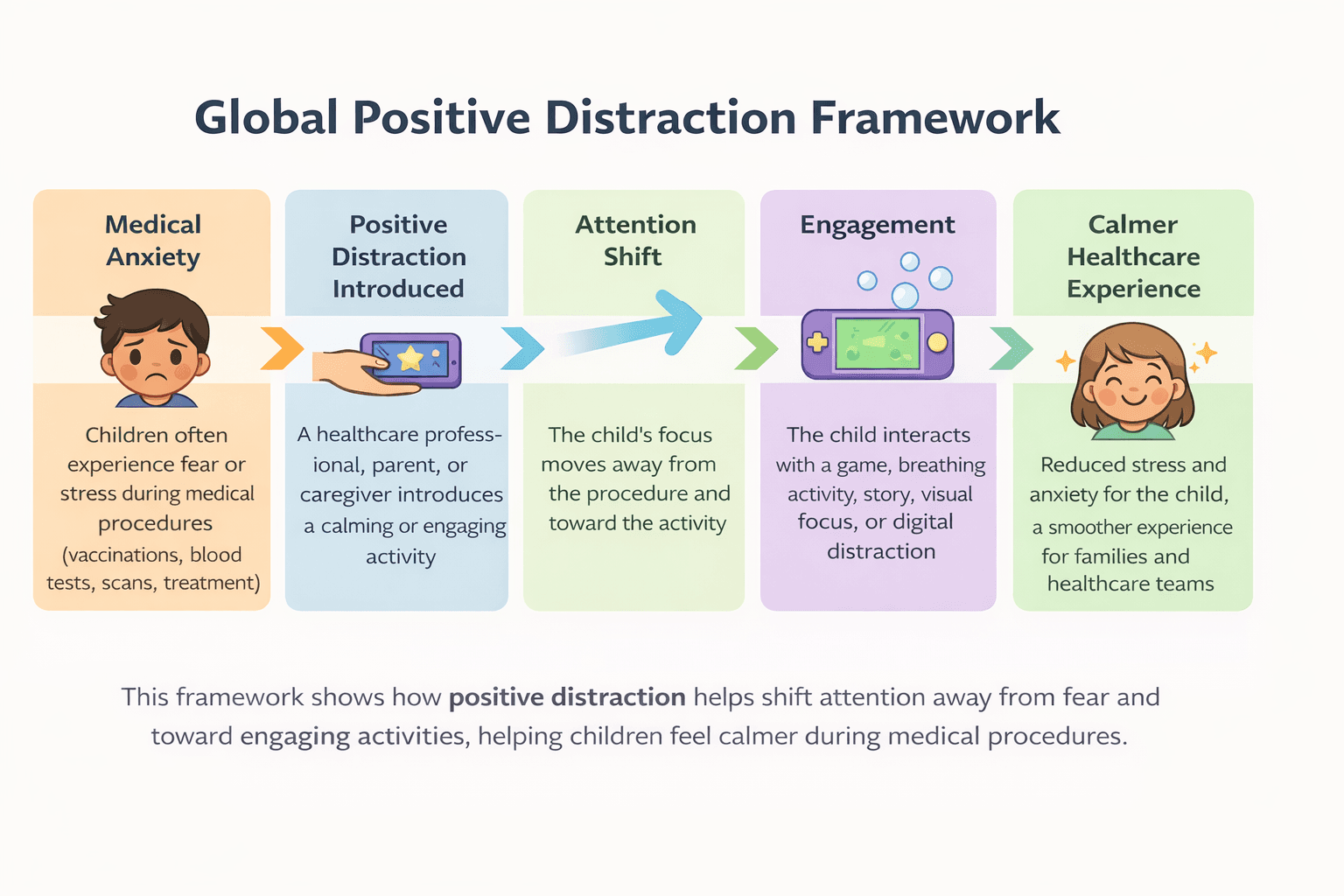
This framework shows how positive distraction helps shift attention away from fear and toward engaging activities, helping children feel calmer during medical procedures.
Children often experience heightened anxiety during medical procedures.
This anxiety can affect how they respond during treatment and can influence how they feel about future healthcare experiences.
Research and clinical practice increasingly recognise the importance of child-centred care approaches that support emotional wellbeing during treatment.
Distraction techniques are widely recognised in paediatric healthcare as a way to support children during procedures, a principle supported by many organisations.
These approaches align with guidance from organisations such as the World Health Organization and leading hospitals including the Royal Children’s Hospital Melbourne, which emphasise the importance of reducing fear and anxiety for children receiving healthcare.
The Global Positive Distraction Protocol is a developing framework that explores how distraction techniques can be applied consistently to support children during medical procedures.
The protocol focuses on simple, accessible approaches that can be used in a wide range of environments including:
The goal is not to replace medical care, but to complement it by supporting children emotionally during treatment.
By providing a moment of calm or engagement, healthcare providers can help children feel more supported during difficult experiences.
Positive distraction techniques may include:
These techniques help redirect attention away from the medical procedure and toward something positive.
Even a short moment of distraction can help reduce stress during treatment.
Technology has made it easier to provide distraction quickly and consistently in healthcare environments.
Digital tools can offer engaging activities that help children focus on tapping, counting, moving, or breathing rather than the procedure itself.
Because these tools can be accessed instantly, they are particularly useful in busy healthcare environments.
Digital positive distraction can support healthcare professionals, families, and caregivers when a child needs a moment of calm.
The Tap 2 Distract app is one example of how digital positive distraction can be used to support children during stressful moments.
Tap 2 Distract provides simple interactive activities designed to help children focus on something positive during medical procedures.
The app can be used during vaccinations, blood tests, hospital visits, or other challenging situations where a child may feel anxious.
Learn more about the Tap 2 Distract app
Helping children feel supported during healthcare experiences is an important part of child-centred care.
Positive distraction techniques provide a simple way to support emotional wellbeing during treatment.
When children feel calmer and more supported, the healthcare experience can become easier for children, families, and healthcare professionals.
The Global Positive Distraction Protocol represents an opportunity to explore how simple distraction techniques could be applied more consistently in healthcare environments around the world.
By sharing knowledge and practical tools, healthcare providers can help create calmer and more supportive experiences for children facing medical treatment.
Help provide these moments of calm and support to more children and families. Donate here
Learn more about our Theory of Positive Distraction
Learn more about how positive distraction helps reduce stress and anxiety
Explore distraction techniques used in hospitals
Written by TLC for Kids, an Australian charity supporting children and families during serious illness since 1998.
Get our latest news and updates in your inbox.